 15 Minute Read
Contents:
Qualification Level: Level 3
Age Group: 16-19 years
Cost: Free in state schools
Skills Developed: Technical skills + theoretical knowledge
Learning Environment: 80% classroom-based, 20% industry placement (45 days)
What are T Levels?
T Levels, or Technical Levels, are Level 3 vocational qualifications designed for 16 to 19-year-olds in England. Equivalent in size to 3 A Levels, they combine classroom learning with practical industry experience, including a minimum 45-day placement with an employer.
If you’re interested in the practical aspects of STEM or prefer hands-on learning, a STEM T Level could be a good fit.
Why were T Levels introduced?
The government introduced T Levels as part of wider reforms to post-16 education, with the aim of simplifying post-GCSE options and improving the quality of technical and vocational education.
Another goal of T Levels is to provide a clearer route into skilled employment, as well as progression to apprenticeships and further study. Developed in partnership with employers, T Levels aim to equip students with the knowledge and practical skills needed in the workplace.
What T Level courses are available within STEM?
There are currently 20 T Levels available across a wide range of industries, with STEM subjects particularly well represented. Below we’ve compiled a list of the STEM-related T Levels currently available.
STEM-related T Level courses
Science
- Science
Engineering and Manufacturing
- Design and Development for Engineering and Manufacturing
- Engineering, Manufacturing, Processing and Control
- Maintenance, Installation and Repair for Engineering and Manufacturing
Construction and the Built Environment
- Building Services Engineering for Construction
- Design, Surveying and Planning for Construction
Digital (Computing)
- Digital Data Analytics
- Digital Software Development
- Digital Support and Security
Health
- Health
Agriculture, Environmental and Animal Care
- Agriculture, Land Management and Production
- Animal Care and Management

How do T Levels work?
What is the course structure of a T Level?
T Levels are split into approximately 80% classroom learning at your school or college and 20% industry placement. The classroom component forms the basis of the Technical Qualification (TQ) you’ll earn, while the minimum 315-hour (45-day) industry placement provides practical experience in a real workplace.
T Levels were developed with input from employers, industry experts, and education providers, ensuring the qualification reflects the skills needed in industry.
The Technical Qualification (TQ)
All students on a T Level course begin with core content, covering essential theories, concepts, and skills relevant to their chosen industry. Once you’ve built a solid foundation, you can choose one or more occupational specialisms to explore in greater depth. This is your chance to focus on areas that truly excite you.
“Classroom-based learning” isn’t just about sitting at a desk. Depending on your course, you might spend time in a lab or workshop. Practical learning and technical skills are just as important as theory in T Levels.
T Levels are typically more content-heavy than many other Level 3 vocational qualifications, due to the rigorous curricula and high number of guided learning hours. Students should expect a full-time, structured and demanding timetable.
English, maths, and digital skills are a key part of the classroom-based element. If you haven’t achieved a grade 4 or above in English and Maths at GCSE, you’ll work towards these qualifications during your studies.

How does the industry placement in a T Level work?
One of the main draws of the T Level programme is the industry placement. This runs for a minimum of 315 hours (approximately 45 days). If an employer can’t offer the full duration, they can share the responsibility with another employer, with your school or college coordinating the arrangement. Depending on your course, the placement may happen as day release, in a single block, or across several blocks.
Your school or college will usually arrange a placement with an employer relevant to your chosen subject. However, if you have a particular company or role in mind, you may be able to help find your own placement, subject to your provider’s approval. Wherever possible, the placement should relate to your chosen occupational specialism.
T Level placements differ from traditional work experience due to their length and depth. You’ll have the opportunity to develop practical skills, build confidence in the workplace, and gain real-world experience of your chosen career. Employers are expected to support your learning and provide a structured placement that complements your studies.
Unlike apprenticeships, T Level placements form part of a full-time education programme, so employers are not required to pay students. Some employers may choose to pay students or reimburse expenses, but this is entirely voluntary. A successful placement can help students build valuable professional contacts, secure strong references, and, in some cases, progress into employment or an apprenticeship after completing their T Level.
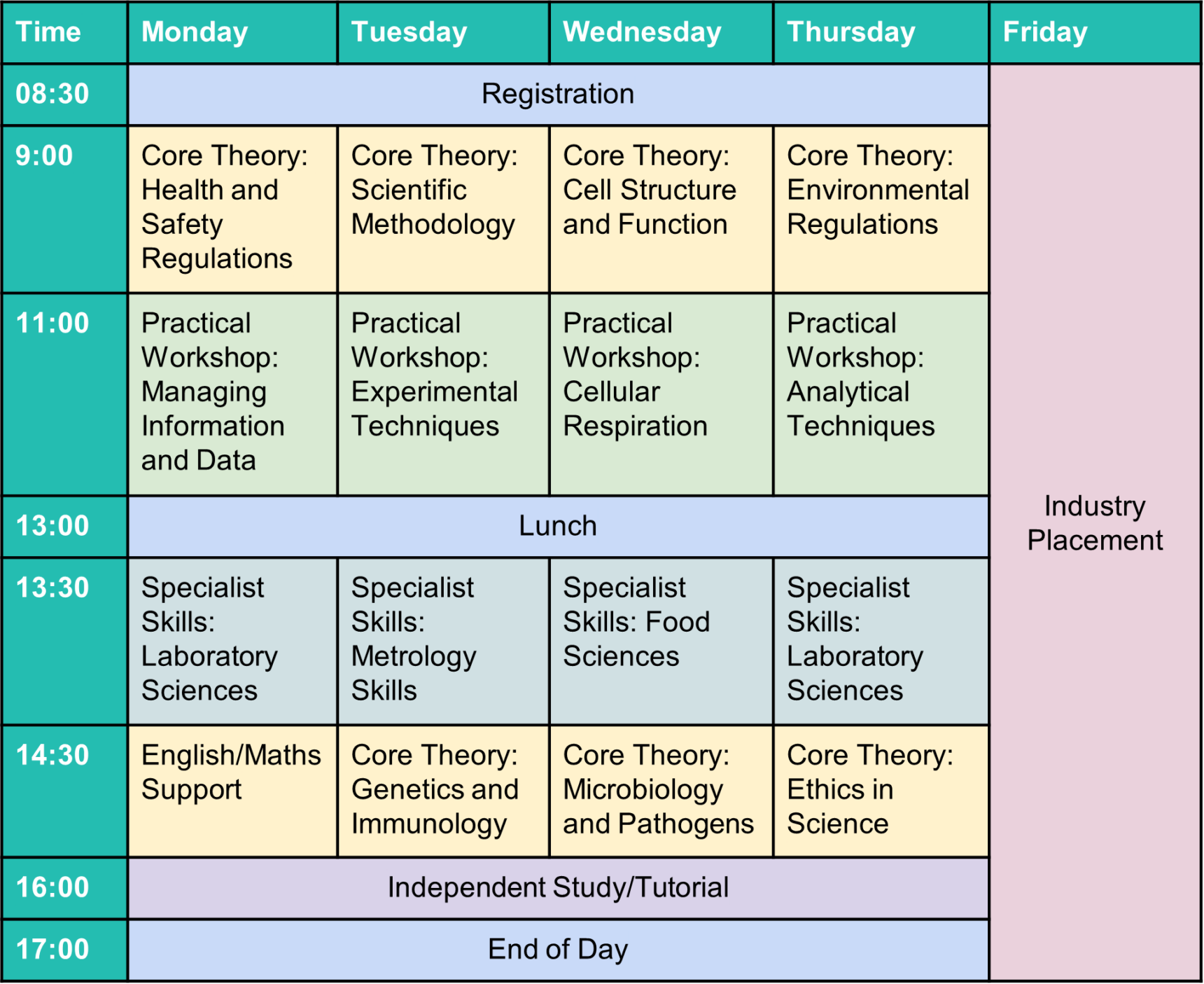
A week in the life of a STEM T Level student
Below is a typical timetable for a STEM T Level student. The industry placement occurs on one day per week, aligning with the 80% classroom-based learning and 20% industry placement structure. For this example, the T Level is in Science.
How are T Levels graded?
Only the core and occupational specialism units are graded. The industry placement and other course requirements must be successfully completed for the full T Level qualification to be awarded.
You’ll receive separate grades for the core component and each occupational specialism. The core component is graded from A* to E, similar to A Levels, while the occupational specialisms are graded as Pass, Merit, or Distinction.
Your overall T Level grade is a combination of these individual results and is awarded as Pass, Merit, Distinction, or Distinction* (which can be achieved by earning a Distinction in the occupational specialism alongside an A* in the core component). Your nationally recognised certificate will show your overall grade, the individual component grades, and confirm that you successfully completed the industry placement.
Assessment methods vary depending on the T Level and awarding organisation but typically include a combination of:
- Written exams
- Practical assessments
- Employer Set Projects
Assessments may take place at different points throughout the two-year course rather than only at the end.
If you don’t achieve the full T Level, you’ll receive a Statement of Achievement showing the components you completed and the grades you achieved. Resits are available for certain assessment components, depending on the awarding organisation and the part of the qualification.
For specific details about how your T Level is assessed, speak to your school or college or check your awarding organisation’s guidance.
What is the T Level Foundation Year?
If you don’t meet the entry requirements for a T Level or would benefit from additional preparation, the T Level Foundation Year can help. This one-year course is designed to bridge the gap between GCSEs and T Levels, helping you develop the knowledge, skills, and confidence needed to progress onto a Level 3 course.
During the Foundation Year, you will:
- Develop technical knowledge and practical skills related to your chosen sector
- Improve your English, maths and digital skills where needed
- Build study skills, workplace behaviours, and confidence
You’ll also have opportunities to meet employers, visit workplaces and, in some cases, take part in work experience or other employer engagement activities. These activities provide valuable insight into your chosen industry and help prepare you for future study.
You might consider the T Level Foundation Year if you:
- Need extra preparation before starting a T Level
- Need to improve your English or maths qualifications
- Want to develop your study skills and confidence
- Are exploring different T Level options
- Would benefit from an additional year before beginning Level 3 study
Some of the same providers that offer T Levels also offer the T Level Foundation Year. Speak to your current school or local providers to find out what is available in your area. You can also check out the government’s list of approved T Level providers for more information.
From 2027, the T Level Foundation Year will be renamed the Foundation Year. The new name reflects its wider role in preparing students for a range of Level 3 qualifications, including T Levels.
Are T Levels well recognised?
T Levels were developed in partnership with employers, education providers, and industry experts to help prepare students for skilled employment while also supporting progression into higher education and apprenticeship programmes, including higher and degree apprenticeships.
Do employers recognise T Levels?
If you’re considering a T Level, you might be wondering if employers value them. The good news is that many do. T Levels are designed to combine classroom learning with hands-on industry experience, helping students develop both theoretical knowledge and practical skills. This practical approach is valued by employers.
Recognition can still vary between employers and industries, but awareness and acceptance of T Levels continue to increase as more students complete the qualification and enter the workforce.

Do universities accept T Levels?
Yes, T Levels can be used to apply to university and carry UCAS tariff points, meaning they are recognised within the university admissions system. However, entry requirements vary by institution and by course, so it is important to check specific requirements before applying.
While many universities accept T Levels for at least some courses, particularly those related to the subject studied, some degrees may prefer A Levels or require additional qualifications. As T Levels are still relatively new, universities are continuing to expand how they recognise them in admissions.
As with all post-16 qualifications, researching individual university requirements early on is essential to ensure your chosen pathway aligns with your long-term goals.
| UCAS Tariff points | T Level overall grade | A Level equivalent |
|---|---|---|
| 168 | Distinction* | A*A*A* |
| 144 | Distinction | AAA |
| 120 | Merit | BBB |
| 96 | Pass (C or above on the core) | CCC |
| 72 | Pass (D or E on the core) | DDD |
How do I apply for T Levels?
Applying for T Levels is similar to applying for A Levels, as both are post-16 options typically chosen after completing GCSEs. If your school or college offers T Levels, you should follow their usual application process for sixth form or further education courses. If you’re unsure how this works, speak to your tutor, teacher, or careers advisor for guidance.
If you need to change school or college in order to study a T Level, you will need to check the application process for the new institution. Applications are usually completed online and involve providing details of your current or predicted GCSE grades, and selecting your chosen T Level course. Some providers may have additional steps in their admissions process, so it’s important to check individual requirements.
To locate nearby institutions offering T Levels and explore the courses available, you can use the official T Levels website tool. It’s also a good idea to attend open days at local sixth forms and colleges offering T Levels, as this will help you decide which institution best suits your needs and preferences.

Entry requirements for T Levels
Entry requirements for T Levels can vary by course and provider, as there are no nationally set minimum entry requirements. They are often quite similar to other Level 3 qualifications. Typically, providers will require a minimum grade in GCSE English and maths (often grade 4 or above), although this can vary between courses and institutions.
It’s a good idea to check the specific entry requirements with the school or college you’re interested in. If you don’t meet their requirements, consider discussing your situation with them, as they may consider applications on a case-by-case basis.
Factors to consider when choosing your T Level provider and course
As with any relatively new qualification, T Levels are continuing to develop and expand, and experiences can vary depending on the provider and course.
Taking the time to research your options carefully will help you choose a provider and course that best suit your goals.
It’s a good idea to consider the following:
Timetabling – How are the required teaching hours structured across the week, term or year? How is learning divided between classroom-based study and practical sessions in workshops or labs? Will the industry placement take place in a single block or be split across the year (for example, through day release)?
Industry placement opportunities – Does the provider have experience in securing industry placements for students? Do they have established employer partnerships, or will placements be arranged closer to the time? Consider how confident you feel about the placement support offered.
Specialism options – What occupational specialisms are available within the course, and do they align with your interests and career goals?
Provider experience – Has the school or college delivered T Levels for several cohorts, or is this their first time offering this qualification? While T Levels are still a relatively new qualification, you may also want to consider their wider experience with vocational courses such as BTECs.
Progression outcomes – What destinations do students typically go on to after the course, such as higher education, apprenticeships or employment?
T Level Foundation Year – Do they also offer a T Level Foundation Year for your course, if needed?
English and maths support – How does the provider support English and maths development within the course, and what additional help is available if needed?
T Levels vs A Levels: Which is better?
When you’re trying to decide between T Levels and A Levels, it really comes down to your career goals and how you prefer to learn.
T Levels are vocational qualifications that combine classroom learning with a substantial industry placement. They are designed for students who want to develop practical skills in a specific sector and may be looking to progress into skilled employment, apprenticeships, or further study in a related field.
A Levels are more academic qualifications that allow students to study a small number of subjects in depth over two years. They are a common route for students aiming to progress to university.
If you prefer a more practical, career-focused approach with workplace experience, a T Level may be suitable. If you are considering a wider range of university options and want a strong academic foundation, A Levels may be more appropriate.
Ultimately, both pathways are respected qualifications that can lead to further study and career opportunities. The right choice depends on your interests, strengths, and long-term plans.
Are T Levels harder than A Levels?
Both T Levels and A Levels have their own challenges.
A Levels are often considered more academically focused, with students developing a deep understanding of a small number of subjects, typically assessed through final exams.
T Levels combine classroom-based learning with a substantial industry placement and a mix of assessment methods, which include written exams, practical tasks and employer-set projects. They require students to develop both theoretical understanding and applied, workplace-related skills.
T Levels vs other vocational qualifications
T Levels, BTECs, apprenticeships, and NVQs are all vocational qualifications that focus on developing practical skills for specific careers. However, they differ in how they are delivered and the type of learning involved.
- T Levels combine classroom-based study with a substantial industry placement, giving students both theoretical knowledge and real workplace experience
- BTECs are mainly classroom-based qualifications that focus on practical, coursework-led learning, sometimes including optional work experience depending on the course.
- Apprenticeships are paid jobs that combine working in a real role with part-time study, with most learning taking place in the workplace.
- NVQs are work-based qualifications that assess skills and competence in a real job environment, often while the learner is already employed.

T Levels are now an established post-16 qualification that continues to develop as more providers offer courses. As with any qualification, the best choice will depend on your interests, career goals and preferred way of learning.
Taking time to research your options carefully will help you choose the pathway that’s right for you.
FAQs
When were T Levels introduced?
T Levels were first introduced in England in September 2020. They were developed to provide students with a high-quality technical qualification that combines classroom learning with industry experience, supporting progression into skilled employment, higher education, and apprenticeships.
How many A Levels is a T Level worth?
T Levels are broadly equivalent in size to three A Levels and carry UCAS tariff points. They provide a technical and vocational alternative to A Levels, combining classroom learning with a substantial industry placement.
How many T Levels can you take?
Most students study one T Level over two years. T Levels are full-time qualifications with a substantial workload and industry placement.
Can I take an A Level alongside a T Level?
Some schools and colleges allow students to study an A Level alongside a T Level, but this depends on the provider and timetable. As T Levels are full-time qualifications with a significant workload, combining them with additional qualifications is not always possible. Speak to your school or college to find out what options are available.
Do you get paid for T Levels?
No. T Level students are not paid because the industry placement forms part of a full-time education programme rather than employment. Some employers may choose to reimburse expenses or offer a payment, but this is entirely voluntary.
Do online T Levels exist?
No. T Levels are designed to be studied in person because they combine classroom learning with practical teaching and a substantial industry placement. Some providers may use online learning to support parts of the course, but there are currently no fully online T Levels.
 Copy URL


Comments