
 5 Minute Read
Contents:
It’s the start of another school day. The gates open, and students stream through; a uniform wave of matching blazers bearing the embroidered school crest, regulation trousers and pleated skirts, crisp shirts with ties pulled tight, and sensible black shoes. The individual student almost disappears into the collective whole.
The uniform creates a powerful image of equality, giving the impression that every student enters school on an equal footing. That principle extends beyond appearance, reflected in the consistent routines, rules, and expectations that shape the school day.
And there is a good reason for this. Consistency gives schools structure and provides a common approach to behaviour and learning. It can also feel fair: if every student is given the same expectations and opportunities, surely they should all have an equal chance to succeed.
But is it that simple?

The difficulty is that students may look uniform as they walk through the school gates, but they do not all arrive from the same starting point. They bring different experiences, circumstances, strengths, and needs to the classroom. Some may face barriers related to disability or additional learning needs; others may be affected by socioeconomic disadvantage, language, prior attainment, or circumstances at home. What appears fair on the surface may therefore not always give every student the same opportunity to access learning, participate, and make progress.
Recognising these differences raises an important question: what does fairness really mean in education?
Equality vs equity: Interchangeable terms or different approaches?
When we talk about fairness in education, the terms equality and equity are often used interchangeably. Although the distinction between them may initially appear subtle, it has significant implications for how we understand fairness and, importantly, how we support our students. Both are grounded in the principle that every student should have the opportunity to succeed, but they take different approaches to achieving this.
So, what is the difference between equality and equity?
Equality
Equality in education focuses on ensuring that all students have access to the same rights, opportunities, and expectations, without unfair bias or discrimination. For teachers, this means using a consistent approach to teaching, classroom expectations, and assessment, while ensuring opportunities are not influenced by factors such as background, gender, race, or disability.
In practice, this might include:
- Providing all students with the same learning resources
- Setting the same learning objectives
- Applying consistent behaviour expectations
- Providing equal opportunities to participate and contribute
- Giving students the same amount of time to complete a task
- Using common assessment criteria

Equality provides an essential foundation for fairness. Without it, students may face discrimination or bias because of their circumstances or needs.
But is equality on its own enough?
Imagine two students being handed the same physics test. One is fluent in English, while the other only began learning the language two years ago. Both are given the same paper, instructions, and amount of time. On the surface, they have been treated identically. But the second student’s understanding of English may prevent the test from accurately reflecting what they know about physics.
Or imagine that every student is given the same homework and deadline, but one has a quiet room, laptop and internet connection at home while another has none of these things. The opportunity might be the same, but their ability to access it is not.
Applying equality too rigidly in the classroom can inadvertently reinforce or potentially exacerbate existing inequalities.
This is where equity comes in.
Equity
What does equity mean? Equity recognises that students do not all have the same needs or experience the same barriers to learning. While equality focuses on providing the same opportunities, equity considers what individual students may need to access those opportunities and participate fully in learning.
For teachers, this means looking beyond a one-size-fits-all approach and considering how teaching, resources and classroom practice can be adapted to meet individual needs. This might include providing additional scaffolding, adapting resources, offering targeted academic support, using different approaches to explain a concept, or making appropriate adjustments to how a student accesses a task.
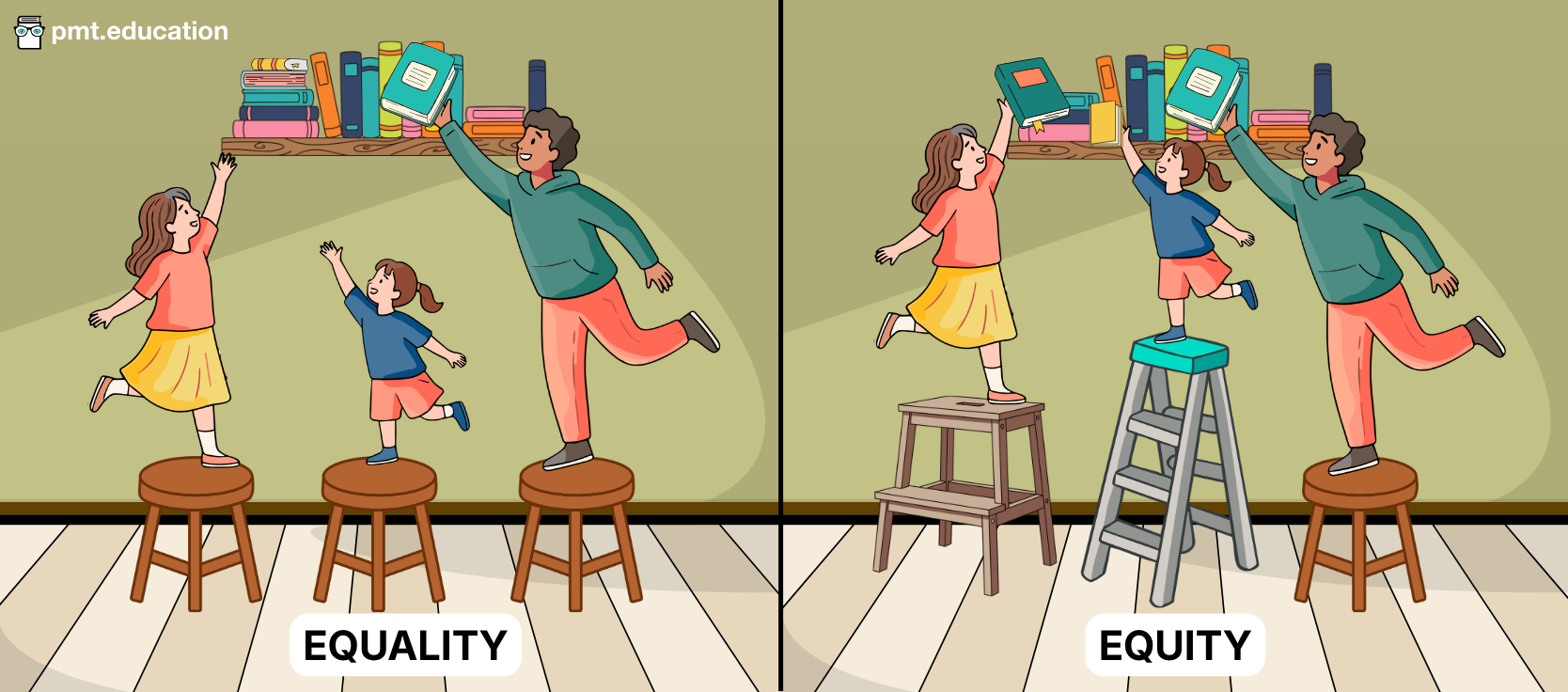
The aim is not to lower expectations or give some students an advantage, but to remove or reduce barriers that may prevent them from engaging with learning and making progress. Equity is therefore about responding to individual needs while maintaining high expectations for all students.
Examples of equality vs equity in schools include:
| Example | Equality | Equity |
|---|---|---|
| Behaviour and discipline | Clear rules and behavioural expectations are set for all pupils. | Accommodations such as a tailored behaviour plan, strategic seating, pre-cueing transitions and sensory breaks may be put in place for a student with ADHD |
| Class discussion | Everyone is given five minutes to write down their thoughts before a class discussion. | A student who needs additional support to organise their ideas may be given a structured discussion template or sentence starters. |
| Homework | All students are given the same homework and deadline. | Pupils who face barriers to completing homework may be given additional support, such as access to a supervised homework club or, where appropriate, an adjusted deadline. |
| English lesson activity | The teacher gives every student the same copy of a text to analyse | An EAL student who has difficulty understanding written texts may be given a bilingual dictionary and extra visuals ,such as images, to aid their understanding. |
| Introducing a new concept | The teacher spends 20 minutes explaining the core concept to all students. | The teacher may provide a summary of key vocabulary, visual diagrams or worked examples broken down into smaller steps for a student with dyslexia student with dyslexia. |
Equality and equity are complementary concepts
It is important to recognise that equality and equity are not mutually exclusive. Schools need both.
Equality establishes what should be available to everyone. Equity considers what may be needed to make that access meaningful.
Equality is the goal; equity is how we get there.
When we champion both, we create a classroom where the bar is kept high for everyone but the support is tailored to the individual. We move away from a ‘one size fits all’ mentality and build a classroom in which every student can thrive.

 Copy URL








Comments