

 13 Minute Read
Contents:
I have a personal pet peeve to share with you today: the well-intentioned but, hopefully by the end of this article, you’ll agree, terrible use of ‘action-reaction’ to explain Newton’s third law.
More often than not, as both a teacher and tutor of GCSE/A Level Physics and Mathematics, I have students come to me with prior experience of this law. If they struggle with applying it, I say to them, ‘Let me guess, you learnt that Newton’s 3rd law means that for every action there’s an opposite and equal reaction?’, with the resounding answer always being ‘Yes’.
Through further discussion with these students, it has become clear to me that this way of explaining it leads to misconceptions and the inability to apply Newton’s third law in depth.
Now, teachers aren’t to blame; textbooks and Google searches are rife with this statement because it rolls off the tongue so easily.
Admittedly, in my first few years as a physics teacher, I also thought that this was the quickest and easiest way to impart this knowledge. So why have I changed my mind on this, and how do I teach it these days?
In this article, I’ll share my thoughts on this topic, and I’ve also included a free worksheet for you and your students.
But before we start, I have a caveat – or footnote, if you like – because, as with all things in physics, the ‘truth’ is not straightforward. Ultimately, the framework presented here works for classical Newtonian mechanics and should help students studying secondary school physics. It is not intended to paint a complete picture, as it cannot accurately describe scenarios found in quantum or relativistic mechanics.
Why I dislike ‘action-reaction’
In a nutshell, I believe the language we use to describe and explain concepts matters.
We should ensure it does not introduce any misconceptions. It’s why we spent so much time discussing weight to ensure students don’t confuse it with mass. But when it comes to ‘action-reaction’, the potential misconceptions may not be as apparent.
In my experience, I’ve found that there are two linguistic ways in which students can develop misconceptions when using ‘action-reaction’, which then prevent them from applying Newton’s third law correctly:
- Students think the ‘reaction’ part of Newton’s third law is linked to the normal reaction force.
-
Students think the ‘reaction’ force acts after the ‘action’ has taken place.
Let’s unpack these misconceptions a little bit and see how we can avoid them.

In the UK, we use the term ‘normal reaction’ or sometimes just ‘reaction force’ to describe the contact force that acts at 90 degrees between two touching surfaces.
Other parts of the world, such as Australia and New Zealand, avoid this nomenclature by calling it the ‘normal contact force’ instead. I personally prefer the latter as it does not imply something is ‘reacting’, but alas, in UK mark schemes you will see ‘normal reaction’ and hence we all feel inclined to have to use it.
Since students also learn that, in Newton’s third law, the forces discussed are of equal magnitude and act in opposite directions, many incorrectly conclude that the following example of a book lying on a table in equilibrium is an example of Newton’s third law.
They conflate the ‘reaction’ part of Newton’s third law with the normal reaction force (N), and since the magnitude of the weight (W) and normal reaction are indeed equal, and the forces act in opposing directions, it’s no surprise that this misunderstanding arises.
What’s worse, I’ve seen a textbook and online articles make this claim, which is even more concerning!
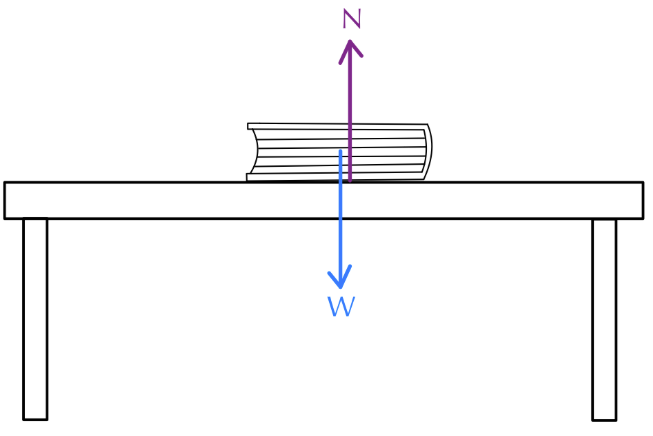
Figure 1: Even though the weight and normal reaction forces are equal in magnitude and opposite in direction, they are not an example of Newton’s 3rd law.
A less serious ‘offence’ – especially at GCSE level, where it has little impact because it is not explicitly assessed in the syllabus – is that students may think the forces in Newton’s third law are dependent on each other in some way.
Rather than understanding that these forces act simultaneously, they may think that the ‘reaction’ part acts after the ‘action’ has taken place. For example, if I ask students what happens when we press our hand to the wall, they will often tell me that the hand applies a force first and that the wall subsequently pushes back. In reality, both the wall and the hand push on each other simultaneously.
At higher levels in physics, starting at A Level, this type of thinking can get in the way of truly understanding what a force is.
At A Level, we describe forces as interactions between two objects that, generally, share some common property. For example, two charged objects will interact with each other and produce an electrostatic force on each other. Each object will experience the same type of force, of the same magnitude, in opposite directions. The forces act along the same straight line, joined by the centres of the objects, and act at the same time.
This is an example of Newton’s third law of motion. It is most easily demonstrated using two magnets that interact with one another, provided their poles face each other (see ‘Delving a little deeper’ below as to why).
Newton’s third law: All forces come in pairs
So, how do I teach Newton’s third law these days?
Many years ago, I took inspiration from these Institute of Physics’ explanations. They, too, highlight the need for moving away from the ‘action-reaction’ conundrum, as it’s proven not to be very helpful to students when problem-solving.
I’ve continued to reflect and update my teaching and now tell my students that all forces come in pairs, and that an interaction between objects creates such a pair of forces.
Then I outline the following conditions that must be met for this pair of forces to be a Newton’s third law pair:
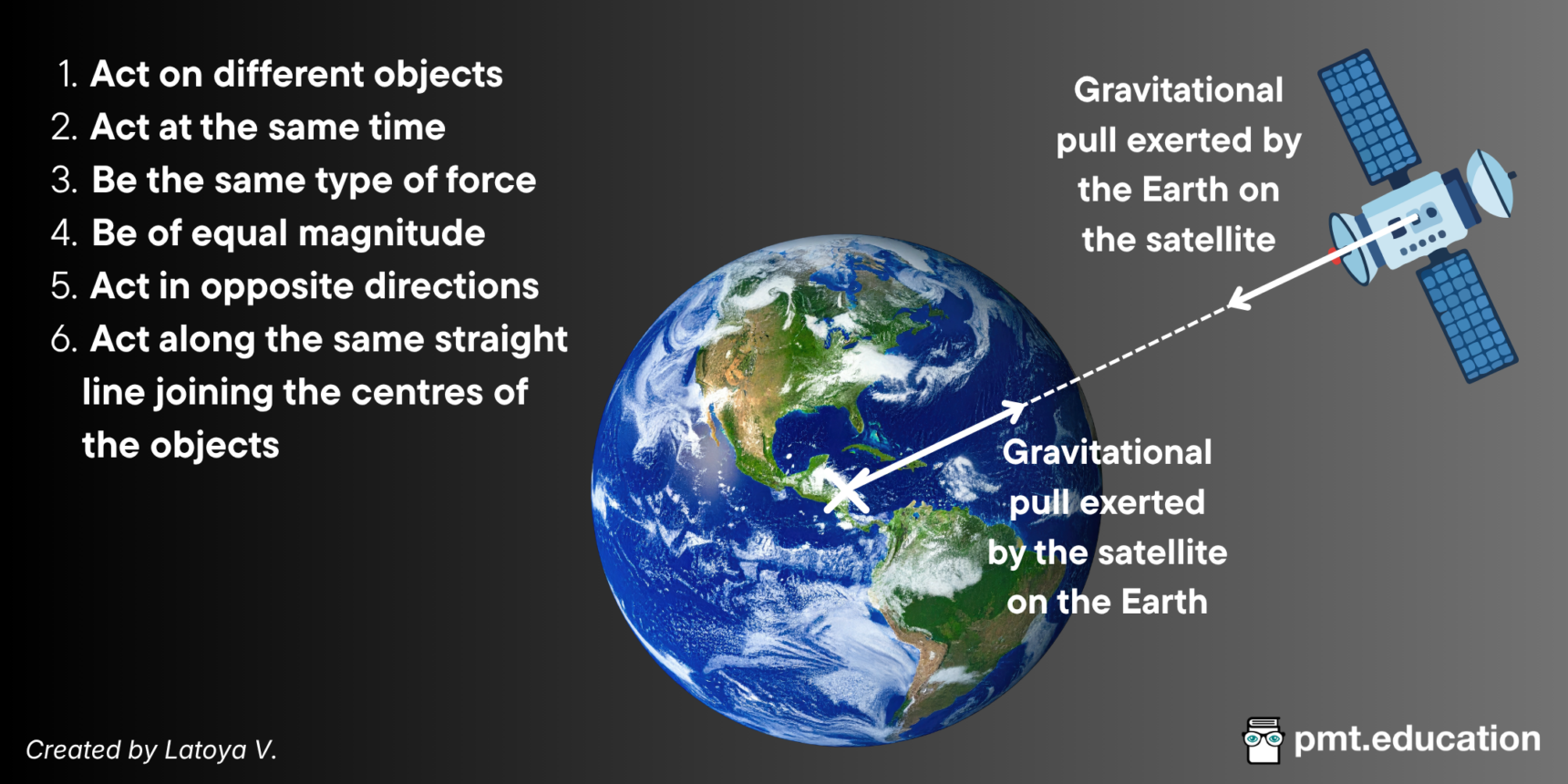
Figure 2: Conditions for Newton’s 3rd law as applied between the Earth and an orbiting satellite (see ‘Delving a little deeper’ with regard to the 6th point about collinearity, which can be chosen to be omitted).
After providing them with this statement and these rules, I give them the situation of the book on the table to analyse. I ask them to:
- Draw all the forces acting on the book
- Apply these six conditions
- Discuss whether the ‘Normal Reaction’ and ‘Weight’ forces constitute a Newton’s third law pair of forces
This is a great group discussion activity, especially if students have already learned about forces in equilibrium. They would hopefully conclude that the forces acting on the book are equal in magnitude and opposite in direction, are collinear and act at the same time, but that they act on the same object and are different types of forces. Thus, they are not an example of Newton’s third law.
To further extend students, we then go back to our original definition of all forces arising in pairs, and ask students what objects the other part of these forces may be acting upon.
This is where you can introduce ideas such as that gravitational forces arise between objects that have mass, but that it’s only significant when one of the masses is the size of an astronomical object such as the Earth. Thus, the gravitational pull from the Earth on the book, or the book’s weight, has a counterpart of a gravitational pull from the book on the Earth.
This can lead to further discussion and reflection on why the Earth, if also pulled by the same amount of force, does not appear to be moving, or about how gravity can be thought of as space-time curvature.
Similarly, the normal reaction force that acts on the book from the table has a counterpart of a normal reaction force on the table from the book.
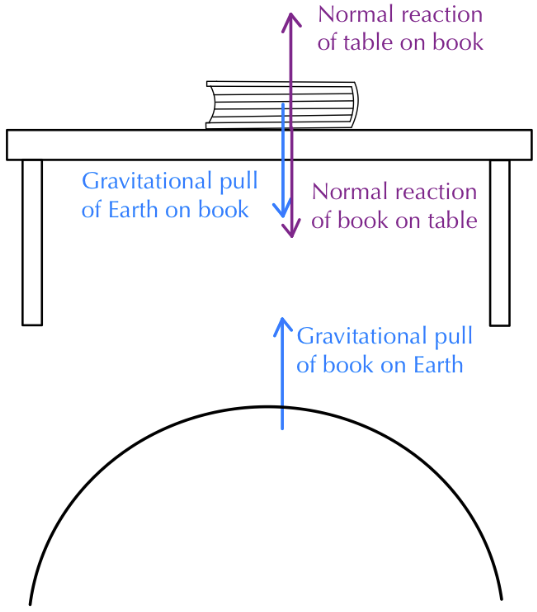
Figure 3: The force pair in blue shows the gravitational interaction between the Earth and the book, whereas the force pair in purple demonstrates an electromagnetic (EM) interaction between the book and the table. Please note that the gravitational interaction between the table and the Earth has been omitted for clarity.
To further develop your students’ understanding of Newton’s third law, it can be worth looking at various examples where students identify which forces constitute a Newton’s third law pair of forces.
I’ve created a free worksheet for you that you can access here.
- You can start with all the forces drawn and all objects involved, and have students correctly pair them up. This also makes for great revision on contact and non-contact forces.
- You can further illustrate this with demonstrations using two magnets with their poles facing each other, or even with a rocket balloon.
- Subsequently, asking students to add the forces themselves for objects interacting in various situations can further consolidate their learning, along with previous ideas about how to draw force vectors.
- As an extension activity, you could ask students to try to analyse a scenario where two books rest on top of each other on a table.
It is also possible to explain that tension in a string or chain can be shown to be an example of Newton’s third law. However, if considering the varying tension between individual links in a heavy chain, this becomes quite advanced and may only be achievable for top students at A Level.
Delving a little deeper
This final section offers some further background information and may help if you run a demonstration that doesn’t appear to work or face deeper student questions. It uses some concepts that are beyond the A Level specification. I hope it adds a little depth or serves as a useful refresher, but feel free to skip it entirely!
Our 6th condition, stating that the forces act along the same straight line (collinear) joining the centres of the objects, is technically known as the ‘Strong Form’ of Newton’s third law.
While points 1–5 (the ‘Weak Form’) ensure linear momentum is conserved, point 6 ensures that angular momentum is conserved, which prevents objects from spontaneously spinning.
While you don’t need to stress the term ‘Strong Form’ to a GCSE or even an A Level class, it does indicate why exam questions that ask students to, for example, draw the gravitational forces between a satellite and a planet – both modelled as spheres – must be drawn along the line that joins their centres of mass.
To keep things simple, you can, of course, ignore point 6 altogether and just emphasise the correct way to draw the forces without explaining why.
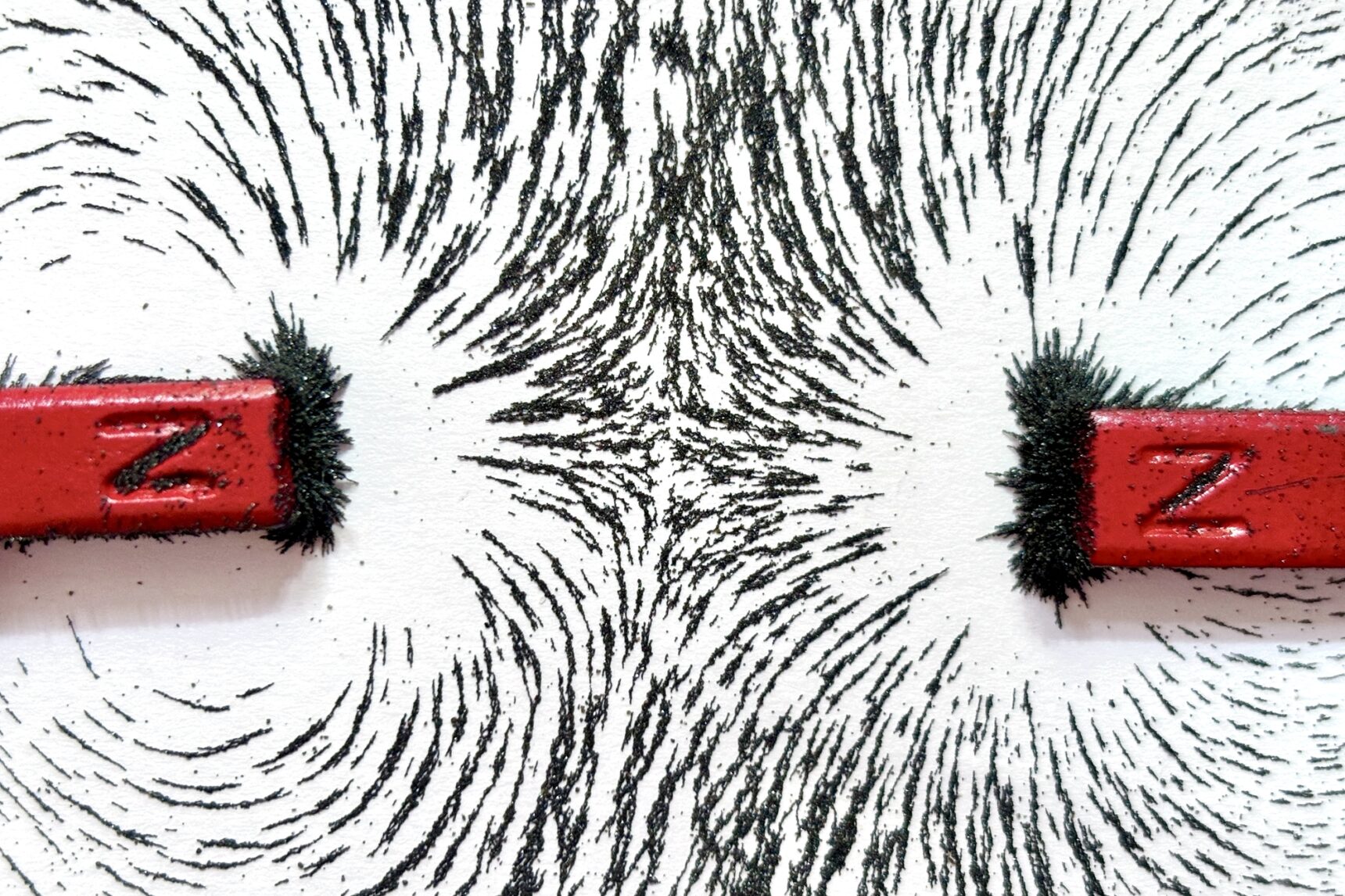
In secondary school labs, students may also get confused by setups that require more complex discussions to correctly explain what is happening.
This is most likely going to occur when looking at scenarios such as:
Two bar magnets interacting at right angles
If you place the north pole of one bar magnet near the side of another bar magnet at a 90° angle, they will rotate.
Students may think this completely violates Newton’s third law. In reality, the net forces are still perfectly equal and opposite, meaning the Weak Form is completely obeyed.
However, because of the 90° geometry, these net forces do not act along the straight line joining the centres of the two objects. This violates collinearity, and thus the Strong Form, creating a torque that causes the rotation.
Because the torques on both magnets are equal and opposite, Newton’s third law is preserved, but it serves as a great warning for teachers about how a simple classroom demonstration can quickly lead to complex questions about collinearity and angular momentum.
To avoid this, ensure the poles of the magnets face each other perfectly, as this will prevent rotation.
Friction on an accelerating wheel
If a car accelerates forward, the road pushes the bottom of the tyre forward. Because the axle of the car is located much higher than the ground, it can look like the interacting forces are spatially offset.
However, this is a confusion between torque and linear force.
The Newton’s third law pair exists strictly at the contact patch where the rubber meets the asphalt: the tyre pushes the road backwards, and the road pushes the tyre forwards with an equal and opposite force.
Because these two forces act at the exact same contact interface, they are perfectly collinear, thus obeying the Strong Form. The vertical distance between the ground and the axle simply creates a torque that allows the wheel to rotate, which is governed by Newton’s second law for rotation, rather than breaking third law collinearity.
To truly break Newton’s third law without any contact or macroscopic geometry tricks, you have to leave classical particle mechanics and look at classical electrodynamics with isolated, independent moving charges.

This is a famous ‘pedagogical paradox’ taught to second or third-year physics undergraduates, which I’m merely including here for the sake of interest:
- Imagine charge A is at the origin and moving along the y-axis, while charge B is moving along the x-axis away from the origin.
- Because magnetic forces depend on the velocity vector of the charge, we find that charge A exerts a magnetic force on charge B, which pushes it sideways.
- However, because of the geometry of charge B’s path, it exerts zero magnetic force back on charge A at that exact moment.
This completely shatters Newton’s third law as magnitudes are unequal, directions are not opposite, and they do not share a straight line.
The resolution to this paradox lies in rethinking what is actually interacting. If forces only exist because objects share a common property, we must remember that the particles aren’t interacting with each other directly; instead, they are interacting with the electromagnetic field.
Because changes in this field take time to travel across space, the field itself temporarily absorbs the ‘missing’ momentum of the interaction, balancing the cosmic ledger until it reaches the other charge.
Newton’s third law isn’t truly broken; it has just been transferred to the field. We don’t cover this because the ideas and equations are far beyond what a secondary school student is expected to understand.
It does, however, highlight another way students can be asked to think about Newton’s third law: the conservation of momentum of an isolated system.

If we consider a standard collision between two isolated macroscopic objects, the total momentum of the system must remain constant. As force is the rate of change of momentum (Newton’s second law), any momentum gained by one object must be lost by the other.
At A Level, students should have enough mathematical skill that this link between the weak form of Newton’s third law and the conservation of linear momentum can be shown*.
For the strong form, we’d also need to demonstrate that this is true for angular momentum, which is a possible extension for AQA students studying the engineering option paper.
*Apologies for not including the mathematical proof here. It would simply bog down the text. However, a quick Google search should lead you to it.
Ultimately, these ideas serve as a powerful reminder that the physics we teach in secondary school has limitations, and that many links exist between topics that may appear disconnected.
Acknowledging this isn’t a failure of the curriculum, but rather an invitation to curiosity. I’d also like to make it clear that as teachers of secondary school physics, we cannot be expected to know it all. Physics is a huge subject, and after 15 years of teaching and completing a physics degree, I, too, am still learning. I think it’s important, and even scientific, to demonstrate that in front of our students.
It’s okay not to know; just stay curious and alter your perspectives and understanding when faced with new information. Demonstrating this to our students shows that we, too, are scientists.

 Copy URL







Thanks Latoya. A really helpful and clear explanation.